What Is a Sentence Rewriter
A sentence rewriter is a tool that takes a single sentence or short passage and produces multiple alternative versions. Unlike a paraphraser, which rewrites longer text as one cohesive output, a sentence rewriter focuses on refining a specific line or phrase. It typically generates three distinct variations: one that is clear and concise, one that is formal and professional, and one that is creative and engaging. Each version expresses the same meaning using different words, sentence structure, and tone.
Writers use sentence rewriters when they have a line that feels awkward, repetitive, or too informal for the context. Perhaps you wrote something that sounds fine in your head but reads stiffly on the page. Or maybe you need the same idea expressed in different ways for different audiences—a formal version for a report and a casual version for a blog post. A sentence rewriter gives you options without requiring you to brainstorm alternatives yourself.
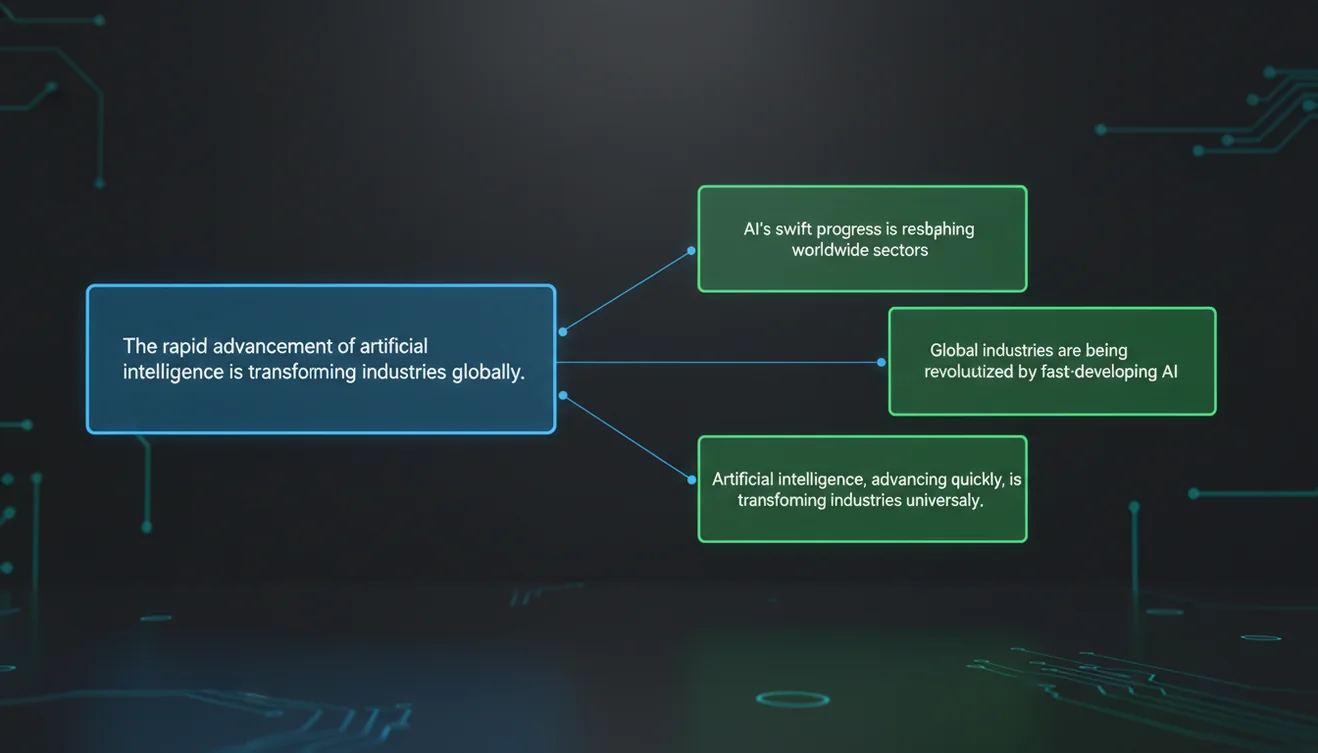
Modern AI sentence rewriters go beyond simple synonym replacement. They understand context, maintain logical flow, and adapt to different tones. The clear and concise variation simplifies complex phrasing. The formal variation uses precise vocabulary and conventional structure suitable for academic or business writing. The creative variation adds vivid language and dynamic phrasing for marketing or storytelling. All three preserve the original meaning while offering distinct stylistic choices.

How AI Sentence Rewriting Works
AI sentence rewriters use large language models trained on vast amounts of text. When you input a sentence, the model encodes its meaning and structure, then generates three new versions that express the same content differently. The process involves synonym selection, sentence restructuring, and tone adjustment. The model applies different stylistic rules for each variation—simplifying for clarity, formalizing for professionalism, or enriching for creativity.
The clear and concise version tends toward shorter words, direct structure, and minimal redundancy. The formal version avoids contractions, uses discipline-appropriate vocabulary, and follows conventional grammatical patterns. The creative version may use more vivid verbs, varied sentence rhythm, and engaging phrasing. The AI balances change with fidelity: each variation should read naturally while preserving the original message.
Use Cases for Sentence Rewriting
Students use sentence rewriters to refine thesis statements, topic sentences, or key arguments in essays. A single sentence can make or break a paragraph; having multiple phrasings helps you choose the strongest version. Professionals use them for emails, proposals, and presentations—especially when a line needs to land with the right tone for a specific audience.
Content creators use sentence rewriters for headlines, captions, and call-to-action copy. A/B testing often requires multiple phrasings of the same message; a sentence rewriter speeds up that process. Non-native speakers find them helpful for finding natural-sounding alternatives when their first attempt feels awkward. The AI Detector and AI Checker on our homepage help identify AI-generated content; a sentence rewriter, by contrast, helps you craft better sentences regardless of how they were originally written.
Clear, Formal, and Creative Styles
Understanding when to use each style improves your writing. Clear and concise works best when your audience needs to grasp the idea quickly—instructions, summaries, or general communication. Formal and professional suits academic papers, business reports, and official correspondence where precision and convention matter. Creative and engaging fits marketing, storytelling, and social media where you want to capture attention and evoke emotion.
You can also mix styles within a document. An introduction might use creative phrasing to hook the reader; body paragraphs might use clear, direct language; the conclusion might return to a more formal tone. A sentence rewriter gives you the raw material—three variations—and you decide which fits each context.
Limitations of Sentence Rewriters
Sentence rewriters work best with short input. Long passages are better handled by a paraphraser. Technical terms, proper nouns, and specialized vocabulary may be altered incorrectly; always review output for accuracy. Subtle nuance can shift between variations—what sounds "formal" to the AI may not match your discipline's conventions. For critical content, human review remains essential.
Sentence rewriting does not replace understanding. If you do not know why one phrasing works better than another, you may choose poorly. Use the tool as a starting point, then apply your own judgment. For legal, medical, or highly technical writing, verify that the output preserves exact meaning and complies with any required terminology.